Marmot has been making technical outdoor clothing since 1974, and its catalogue spans genuine mountaineering kit and affordable everyday layers under the same logo. Knowing which end you are looking at — and how to read the numbers on the label — matters more than any discount.
Fill power is not warmth
The single most misread specification in outdoor clothing, and Marmot publishes it prominently across its down range.
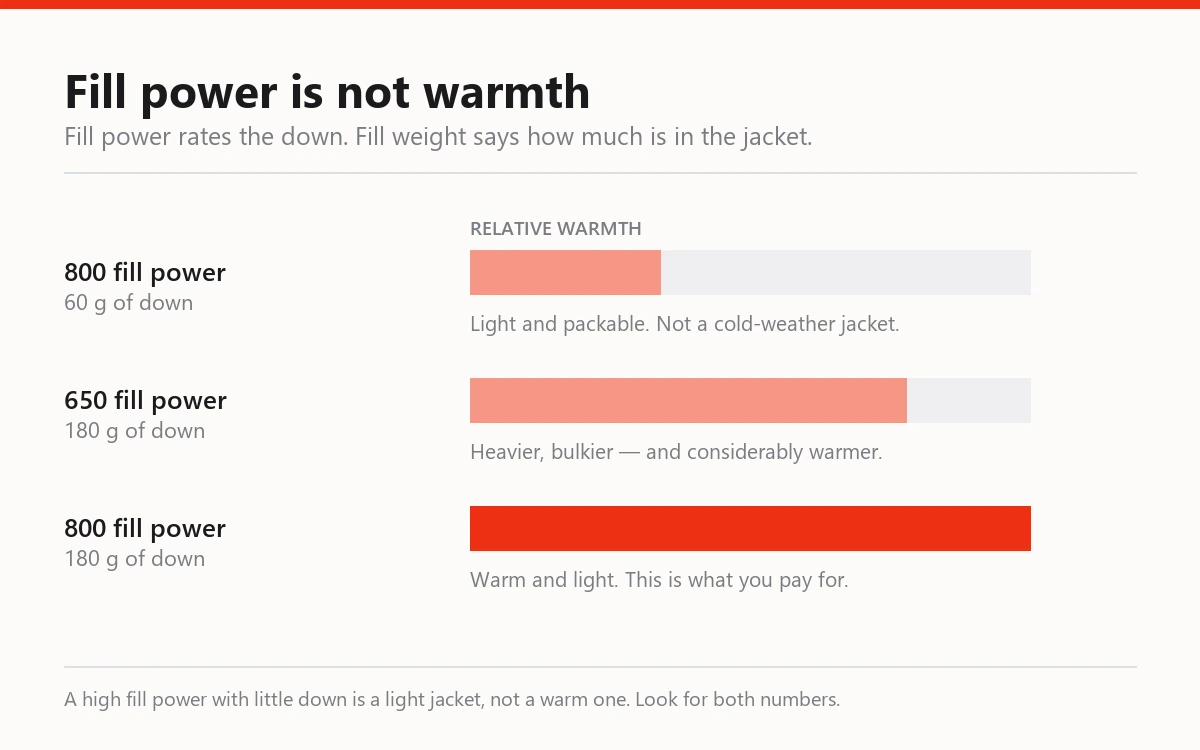
Fill power measures the quality of the down: how much loft a fixed weight produces. Marmot's down jackets span roughly 600 to 900 fill power, and higher means more warmth per gram — a lighter, more packable jacket.
Fill weight is how much down is actually in the garment, and it is far less prominently displayed.
A 900-fill jacket with very little down is light and packable, not warm. A 650-fill jacket with plenty of down is warmer and heavier. Warmth comes from both numbers together. If you are buying for genuine cold and the fill weight is not published, that absence is itself informative.
PreCip is the entry shell, and behaves like one
PreCip is Marmot's long-running affordable rain jacket and probably the product most people own from the brand. It is genuinely good value and widely recommended, which leads to it being bought for conditions it was never designed for.
It uses a coating rather than a laminated membrane. Coatings work well initially and have a finite life — the jacket will eventually wet out no matter how well you look after it. It is a jacket for showers, travel and general use, not a hardshell for sustained mountain weather.
Marmot's higher tiers use proper membranes, which last longer and breathe better. If you are walking in serious weather regularly, that is the upgrade that matters.
When synthetic beats down
Untreated down loses nearly all its insulating value when wet and takes a long time to dry. Synthetic insulation keeps a useful proportion of its warmth damp and dries far faster.
The rule: dry cold means down every time, because it is warmer for the weight and packs smaller. Wet cold, or anywhere you cannot dry a jacket properly, means synthetic even though it is bulkier for the same warmth.
Marmot treats much of its down to resist moisture, which sits between the two — better than untreated down, still not a match for synthetic once genuinely soaked.
The DWR finish, and why your jacket stopped working
The durable water repellent finish on the outside of any shell is what makes water bead. It wears off with use and washing — this is normal and universal, not a Marmot fault.
When a jacket starts wetting out and feeling clammy, that finish usually needs refreshing rather than the jacket needing replacing. A wash-in treatment restores it and costs a fraction of a new shell. A surprising number of jackets are thrown away over this.
Buying for the activity, not the coldest moment
Standing still in the cold wants maximum insulation — down if dry. Moving hard in the cold wants considerably less than people expect, because you generate substantial heat walking uphill and a jacket that is right while stationary will have you soaked in sweat.
Stop-start activity is best served by a lighter insulating layer you can add and remove easily rather than one heavy jacket. The common mistake is buying for the coldest moment of the day rather than the most active one.
Where the reductions come from
Most Marmot codes in circulation are 10%, many issued through affiliate and membership partners rather than the brand directly. They are interchangeable, so trying several achieves nothing:
The meaningful savings are seasonal. Marmot discounts hardest when the season turns, so a down jacket in spring or a rain shell in autumn routinely beats any code by a wide margin. Technical specifications change on a slow cycle — last season's PreCip is this season's PreCip in a different colour, and the same is true across most of the range.
Marmot also warrants its products against manufacturing defects for their practical lifetime, which is worth factoring in when comparing against a cheaper jacket with no comparable cover.
Looking after insulation
Down jackets need washing occasionally — body oils reduce loft, and a dirty down jacket is a colder one. Use a down-specific wash and tumble dry on low with dryer balls to break up clumps. Air drying alone leaves the down matted and the jacket permanently less warm.
Store insulation loose, never compressed. Months in a stuff sack permanently damages loft in a way washing cannot recover.
Repair small tears immediately — down migrates out of a hole faster than seems possible, and a patch costs almost nothing.
Common questions
What fill power should I look for?
The wrong question alone. Decide how warm and how light the jacket needs to be, then read fill power and fill weight together.
Is PreCip waterproof?
Water-resistant to waterproof for its intended use — showers and general wear. It is not a mountain hardshell, and expecting it to behave like one is the source of most disappointment with it.
Can I wear a down jacket in the rain?
Briefly, under a shell. As an outer layer in sustained rain, no — that is what the synthetic option exists for.
| Discount | Type | Get the deal |
|---|---|---|
| 10% off | Promo code | View at Marmot → |
| 10% off | Promo code | View at Marmot → |
| 10% off | Promo code | View at Marmot → |
| 25% off | Promo code | View at Marmot → |